
In this article
A fortnight ago we ran a webinar walking clients through Copilot Cowork. Hand it a whole task and it comes back with the finished work, not a draft. On 16 June 2026 Microsoft made it generally available, and the same announcement put it on a meter. If you bought Microsoft 365 Copilot partly to get this, the timing stings.
Cowork now costs extra on top of the licence
Cowork spent its preview inside Microsoft’s Frontier programme. On 16 June it went generally available, and Microsoft switched on usage billing with it. The Copilot licence still applies, around US$30 per user per month, just to have access. Cowork now charges again, on top, for the work it does.
For a lot of buyers, Cowork was the reason to license Copilot in the first place. It was the capability in the demos, the one that justified the spend to the board. That capability is now a separate, metered bill. And Copilot is usually sold on an annual commitment, so the obvious response, cancelling, is off the table for most people until renewal.
What pay-per-use means for your bill
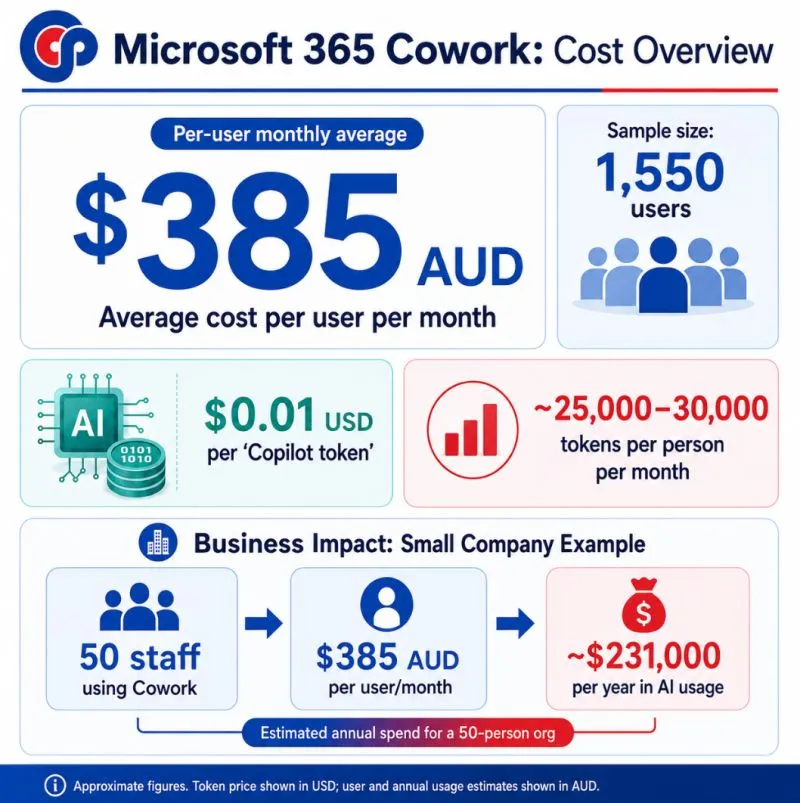
Cowork is metered in a usage currency Microsoft calls Copilot Credits, at one US cent each. You either pay as you go, or pre-commit for a discount. Four things set the price of a task. The model it uses, how much of your material it reads, the tools it calls, and how long it runs.
Microsoft did soften the start in one way. Tenants that used Cowork during the Frontier preview get a grace period, and are not billed until 1 July 2026. Everyone else is on the meter now.
Work out the cost before you switch it on
The capability is real, and used well it earns its keep. That only happens with the groundwork around it. Staff who are trained. Shared skills and approved connections to your other systems, so forty people are not each paying to rebuild the same workflow. And a close watch on the spend from day one.
Left unmanaged, this gets expensive fast. A public cost calculator, built on Microsoft’s own Frontier-usage averages, models one scenario at about 1,550 users. That works out at roughly A$385 per user per month, near US$418,000 a month across the sample, on top of the licences. Treat that as one heavy-usage scenario, not a forecast.
If you want your own number instead of theirs, our Copilot Cowork cost calculator works in Australian dollars. It models your own mix of users and tasks. The danger is not that everyone spends that much. It is that most businesses will not know what they are spending until the bill arrives.
Our read
Microsoft built the controls properly. Cowork is off by default, administrators choose who gets access, and you can set spending limits and alerts. Those are the right tools. Set them up before you switch Cowork on. That is the difference between a managed cost and a surprise.
The blunter point is how Microsoft handled it. Many customers are part-way through an annual licence they took partly for this feature. Moving it behind a new meter at short notice is a rough way to treat the people who backed it early.
It leaves every business with the same two questions. Would you pay around A$385 per user per month, on top of the licence, if the output justified it? And would you give it to everyone? Or hand a few people an agent that does the hardest part of their work while the rest are told to keep up? Those are leadership questions, and they are better answered before the first bill than after it. If you want a hand running a controlled trial of Cowork while it is still cheap to run, get in touch.
Tags
- copilot-cowork
- microsoft-365
- copilot
- copilot-credits
- pay-per-use
- agentic-ai