
In this article
- 01 Frontier preview is over, and the billing has started
- 02 A prompt is one thing. A task is another.
- 03 Agentic AI doesn’t budget like a per-seat licence
- 04 If your staff use Cowork badly, you’ll pay for it
- 05 AI literacy now means knowing what to delegate
- 06 Cowork finishes the work, and it can drive your browser
- 07 Who controls the workflow, and who gets access
- 08 Controls exist. A dashboard isn’t a strategy.
- 09 Genuine step forward, or expensive tool used badly?
Copilot Cowork is the most capable thing Microsoft has shipped under the Copilot name, and on 16 June 2026 it stopped being a preview. Hand it a real objective and it will go and complete the work, start to finish, while you get on with something else. For most businesses this quarter, the capability is not the story. The billing is. What you have to plan for now is the cost, the governance around it, and who in your organisation gets access.
Frontier preview is over, and the billing has started
Cowork spent its preview inside a programme Microsoft branded Frontier, which opened on 30 March. On 16 June it went generally available worldwide, and Microsoft changed the charging model with it. The licence has not gone away. You still pay for Microsoft 365 Copilot, around US$30 per user per month before any volume discount, just to have access. Cowork then bills again, on top, for the work it does.
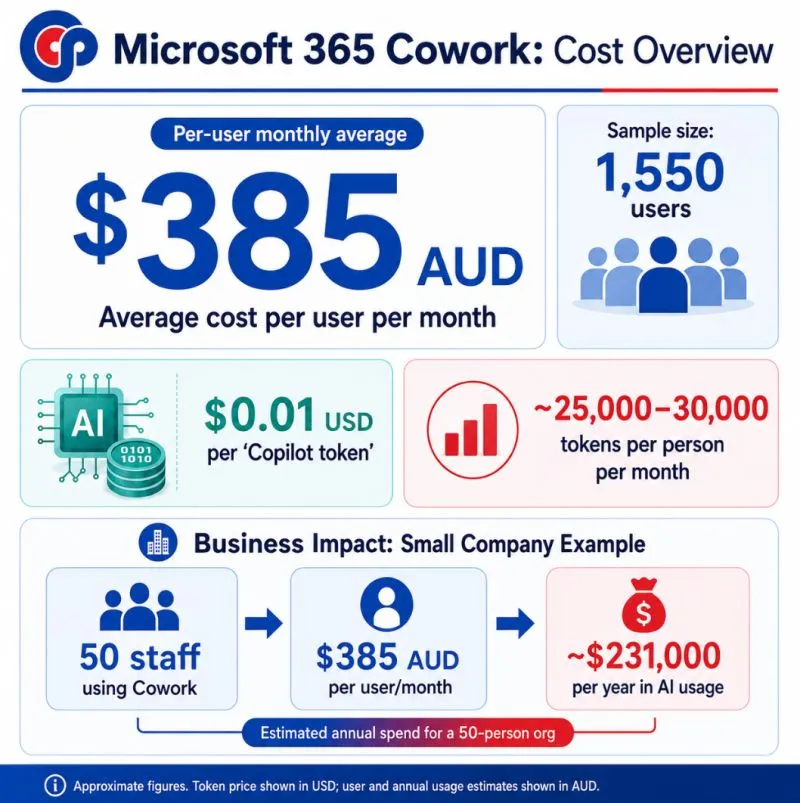
That second bill is the new part. Microsoft meters it in a usage currency it calls Copilot Credits, priced at one US cent each. You can pay as you go, or commit to a block of usage up front for a discount. Billing started on 16 June, with one concession. Tenants that had someone using Cowork during the Frontier preview get a short grace period, and are not charged until 1 July 2026. Everyone else is on the meter now.
You pay for the licence, then you pay again for the work.
A prompt is one thing. A task is another.
A chat prompt is cheap because it does one small thing. You ask, the model answers, you read it, the transaction is over. A Cowork task is a different unit of work. You give it an objective and it runs the steps on its own. It searches, it reasons over your files, it calls tools and third-party plugins, and it can drive a web browser. Then it comes back with finished work instead of a suggestion. This is what the industry means by “agentic”: software that does not just answer, it goes and completes multi-step work for you. It is useful. It is also why it cannot be priced like a chat message.
Microsoft builds each task’s price from four inputs. The four are the model it runs, the context it pulls in from your business, the tools it calls, and how long it runs. It sorts tasks into light, medium, and heavy. A light task reads a few sources, reasons lightly, and produces a single output. A heavy task pulls in far more, reasons deeply, and produces several outputs. The deeper and wider the task, the more credits it burns. Early analyses of those tiers put a light task at roughly one to three US dollars. The same analyses put a medium task at four to seven, and a heavy, multi-output task at seven and up. (Computerworld walked through the arithmetic the day after launch; Microsoft’s usage-based billing guide sets out the mechanism.) A cent a credit sounds harmless. A heavy task uses hundreds of credits, and a workforce runs hundreds of heavy tasks a week.
Agentic AI doesn’t budget like a per-seat licence
We have spent fifteen years buying business software the same way: per user, per month, known in advance. You could put the number in a spreadsheet in January and still be right in December. Consumption breaks that. The bill is the sum of what your people actually did, and people are not predictable. Every heavy task appears on the invoice. So does every vague request re-run three times because the first two missed, and every workflow somebody rebuilds from scratch instead of reusing.
It is easy to make the figure large. One widely shared example is a public Cowork cost calculator built on Microsoft’s own Frontier-usage averages. It models a mixed organisation of around 1,550 people and returns close to US$418,000 a month of Cowork usage, on top of the licences. Treat that as one scenario and nothing more. Change the share of heavy users, or cap what the agent is allowed to do, and the figure moves a long way down. We built a Copilot Cowork cost calculator so you can model your own mix in Australian dollars. Change the inputs and watch how far the number swings. The figure is not the lesson. The unpredictability is.
The quieter risk is the one that actually bites. Most organisations will not know what they are spending until the bill arrives. A per-seat licence cannot surprise you. A consumption bill can, and the first month is usually when it does.
If your staff use Cowork badly, you’ll pay for it
Consumption pricing turns everyday habits into a line item. Four habits cost real money.
- Vague tasking and reruns. A poorly framed task searches more, reasons more, and produces more than it needs to. Someone who is not sure what they asked for then runs it again, and each run bills.
- Everyone rebuilding the same workflow. If forty people each invent their own way to produce the weekly report, you pay for forty heavy tasks. One shared skill the whole team calls would cost you one.
- Connectors and plugins nobody approved. Every plugin a task is allowed to call is a tool call you can be billed for, and a path your data can travel. Leave them open and that list only grows.
- Managers who can’t tell delegation from convenience. Someone has to know which work is worth an agent at heavy-task prices, and which is a thirty-second job a person should just do.
AI literacy now means knowing what to delegate
For two years, “AI literacy” has meant one thing: can your staff write a good prompt. Cowork retires that definition. Prompt-writing is table stakes now. The literacy that matters is judgement about cost and control. Which tasks are worth delegating to an agent, and which are the thirty-second job. Which justify a heavy task’s price, and which belong in ordinary Copilot Chat. Which teams get access at all, and which model each task should use. Which repeated workflows get promoted into a central skill so the team stops paying to reinvent them. Which plugins are approved to be called. Last, how you measure whether the output was worth more than it cost, before the spending gets ahead of you.
Cowork finishes the work, and it can drive your browser
Cowork runs complex, long-running, multi-step tasks and, in Microsoft’s words, “returns a completed result, not just a draft or a recommendation.” Microsoft’s examples are concrete. One edits a batch of spreadsheets and draws the dependency flow chart between them. Another compares one file across several product versions. A third works a sales pipeline and hands back a ranked list of opportunities. It launches with nine third-party plugins, including Harvey for legal work, monday.com, and Miro, with more to follow. This is a layer that does work.
The browser is the part that should get an administrator’s attention. Cowork can drive a local Microsoft Edge session, following the enterprise policies you already have in place. That matters more than it first sounds. A large share of real business work is not in Microsoft 365 at all. It is in portals, CRMs, finance systems and supplier sites, behind a login, with no clean connector. If an agent can operate the browser, it can reach that work the way your staff do, by signing in and clicking. That closes a genuine gap, and it is also the part you most want governed. An agent signed in to a browser session is an agent acting as a member of your staff.
Who controls the workflow, and who gets access
Two questions decide this, and neither one is technical.
The first is control. A single Cowork task can chain the research, draft the email and write the briefing. Then it builds the deck, sets up the follow-up and posts the summary to Teams. At that point a real part of someone’s job happens without them. Who owns that workflow? IT, the business unit that runs it, the person who kicked it off, the plugin vendor whose tool it called, or the agent itself? In most organisations on day one, nobody has decided, which in practice means the agent has.
The second question is sharper, and most leaders have not faced it yet. If Cowork lifts a person’s output, then access to it becomes an advantage at work. So who gets it? Everyone? Only senior staff? Only the revenue teams? Only your proven performers? Each answer has a consequence. Give it to a few and you create a tier of people who produce far more than the rest. Everyone else is told to do more with less. That shows up quickly in who hits their numbers, who gets the credit, who gets promoted, and who gets trusted with the bigger work. An access decision made casually, on cost grounds, can become a decision about your people’s careers without anyone meaning it to.
Controls exist. A dashboard isn’t a strategy.
Microsoft has done the controls properly, and it deserves the credit. Cowork is off by default. Administrators decide when to switch it on and who gets access. You can set spending limits across the whole tenant, meaning your company’s Microsoft environment, or on a group, or on one person. Alerts fire when usage crosses thresholds you choose. When a user hits the limit mid-task, they can request more credits instead of running past the cap unseen. That is the right toolkit, and it is more than most consumption products include.
One piece is missing on day one. Microsoft lists per-task pricing shown to the user as coming after general availability. That is the feature that would let a staff member see a task costs eight dollars before they run it. So at launch your people can spend without seeing the price, while you watch the total climb on a dashboard. Know that before you switch Cowork on.
A dashboard, however good, has a hard limit.
A dashboard doesn’t create a strategy. It only tells you what happened.
Deciding what should happen is your job. Turning Cowork on for the whole company and watching the graph is not the way to do it. Run it like an experiment. Give it to a small group, on real workflows that matter, for a fixed period. Measure two things: what it cost, and what it produced. Compare that against the same work done in ordinary Copilot Chat, or by a person. Where a workflow is repeated, valuable, and cheaper or better as an agent task, promote it into a central skill the team reuses. Where the work is ad hoc, vague, or a person could do it in a minute, keep it out. Cowork earns its keep on reusable, high-value work. It bleeds money on the rest.
Genuine step forward, or expensive tool used badly?
Cowork is a real step forward. The question is whether your organisation is set up to take it well, or will take it expensively and by accident. Two questions settle it.
Would you pay hundreds of dollars per user per month, on top of the licence you already buy, if the output justified it? For some teams and some workflows the answer will be a clear yes. For others it will be waste dressed up as progress. The only way to tell them apart is to measure first, while the spend is still small.
And would you give it to everyone? Or are we about to watch a divide open inside organisations? On one side, the people whose agent does the hardest part of their work. On the other, the people told to keep pace without one. That is a leadership decision, not an IT one, and it is better made on purpose than by default.
This is the work we do with clients before the first big bill, not after it. Switch Cowork on for a controlled group. Put real spending limits and governance around it. Measure cost against output on the workflows that matter. Then decide who gets access, and why, on the evidence. If you are weighing up Cowork for your business, get in touch and we will help you run the experiment while it is still cheap.
Tags
- copilot-cowork
- microsoft-365
- copilot
- agentic-ai
- ai-governance
- copilot-credits
- ai-literacy
- managed-it